
 翻译
翻译
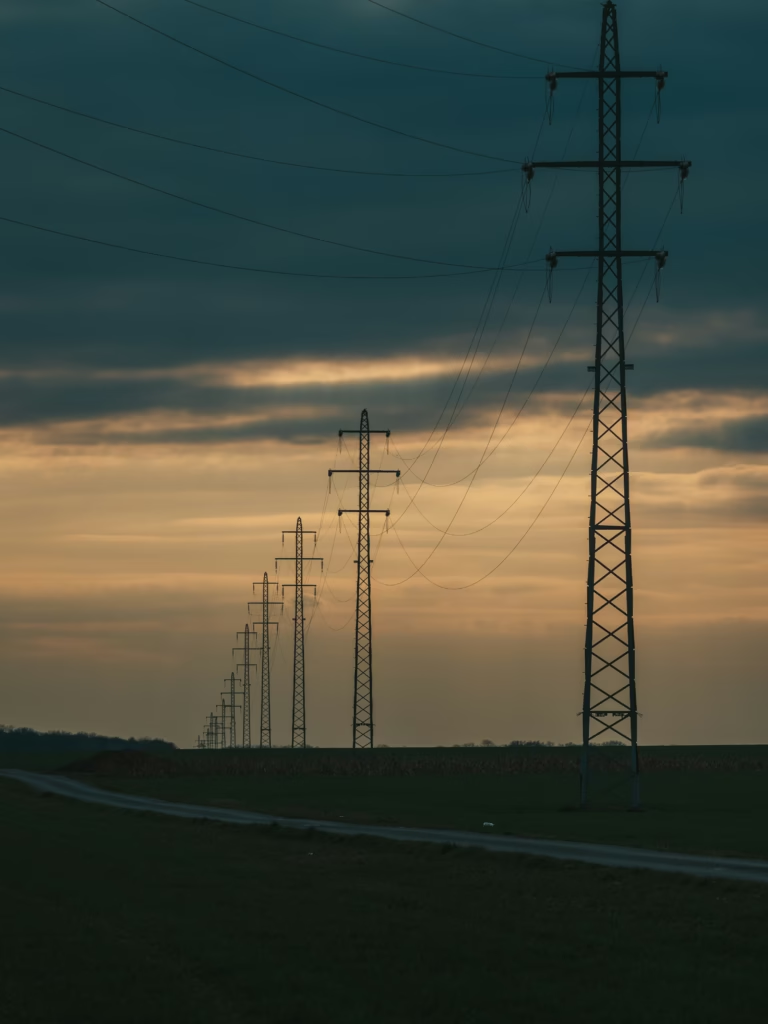
Malaysia’s Energy Commission has begun drafting the regulatory framework that will govern cross-border electricity trading — a significant legislative development following the passage of the Electricity Supply (Amendment) Act, which formally expanded the Commission’s authority to oversee power imports and exports. The new rules, being developed in 2026, will set out the technical, licensing, and economic requirements for any entity seeking to buy or sell electricity across Malaysian borders.
The amendment introduces meaningful enforcement teeth: companies that import or export electricity without the required licence now face fines of up to RM30 million and penalties of up to 10 years’ imprisonment. This signals that Malaysia is moving from a permissive, ad hoc approach to cross-border power to a structured, regulated market — a prerequisite for deeper participation in the ASEAN Power Grid (APG) initiative and bilateral arrangements such as the ongoing Lao PDR–Thailand–Malaysia–Singapore (LTMS) Power Integration Project.
Critically, the government has reaffirmed a domestic-first principle: cross-border electricity trade will proceed only when Malaysia’s own supply surplus is secured. For the energy storage industry, this regulatory evolution is significant in two ways. First, a well-regulated cross-border market will require dispatchable, storage-backed generation to guarantee reliable supply flows. Second, as neighbouring markets — including Indonesia’s proposed US$30 billion solar export project targeting Singapore — seek to route power through Malaysian infrastructure, the case for robust domestic grid storage becomes even more compelling.
Written by Flora Zhang, who covers Malaysia and ASEAN energy storage — policy, tenders and revenue mechanisms — for MESA.