
 翻译
翻译
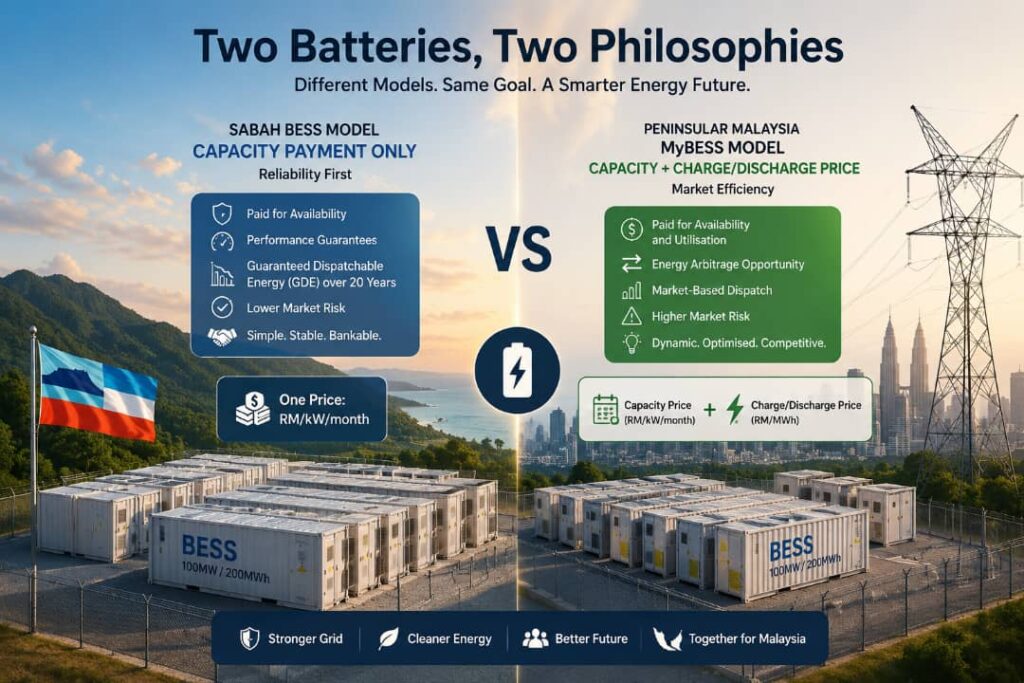
As Malaysia accelerates the deployment of battery energy storage systems (BESS), two emerging procurement frameworks are attracting significant industry attention: Sabah Electricity’s recent BESS tender and the upcoming MyBESS programme in Peninsular Malaysia.
While both initiatives aim to strengthen grid reliability and support the energy transition, they reflect fundamentally different approaches to how energy storage assets are valued and compensated.
Sabah BESS: Prioritising Reliability and System Security
The Sabah BESS tender adopts a predominantly capacity-based procurement model. Under this framework, project developers are compensated primarily for maintaining battery availability and meeting specified technical performance requirements.
In essence, the battery is procured as a strategic grid asset designed to enhance system reliability, improve operational flexibility, and provide long-term support to the power network.
This approach offers several advantages:
- Greater revenue certainty for project developers;
- Lower exposure to market price volatility;
- Simplified regulatory oversight and contract administration;
- Increased attractiveness for infrastructure investors seeking stable, long-term returns.
From an investment perspective, the model resembles the procurement of transmission infrastructure or reliability services, where value is derived from availability rather than frequent market participation.
MyBESS: Introducing a More Market-Oriented Structure
The MyBESS programme, currently being developed for Peninsular Malaysia, is expected to incorporate both capacity payments and operational revenue streams linked to charging and discharging activities.
This structure creates a more dynamic commercial framework, where operators are rewarded not only for maintaining asset availability but also for actively participating in system operations and energy market services.
Potential benefits of this approach include:
- Improved utilisation of storage assets;
- Stronger incentives for operational optimisation;
- Greater overall system efficiency;
- Enhanced opportunities for revenue stacking.
However, the model also introduces additional complexity. Developers and investors will need to evaluate market exposure, dispatch strategies, operational performance, and evolving regulatory mechanisms when assessing project viability.
Different Models for Different Market Objectives
The distinction between the two frameworks reflects differing policy priorities.
Sabah’s model focuses on ensuring grid stability and reliability within a power system that faces unique operational challenges and growing electricity demand. Simplicity and revenue certainty are key characteristics of the procurement structure.
MyBESS, meanwhile, seeks to establish a more market-driven ecosystem where storage assets can provide multiple services and capture value from various revenue streams. Such a model may ultimately improve efficiency and encourage innovation, but it requires more sophisticated market design and risk management.
Looking Ahead
As Malaysia’s energy storage sector continues to evolve, both approaches offer valuable lessons for policymakers, utilities, investors, and technology providers.
The Sabah BESS tender demonstrates how capacity-based procurement can accelerate deployment while providing investment certainty. MyBESS, on the other hand, represents a step towards a more mature and market-oriented storage ecosystem.
Rather than competing models, they may be viewed as complementary pathways reflecting different stages of market development and different system requirements across Malaysia’s electricity landscape.
The coming years will provide important insights into how these procurement structures influence investment decisions, project economics, and the broader growth of energy storage deployment in Malaysia.