
 翻译
翻译
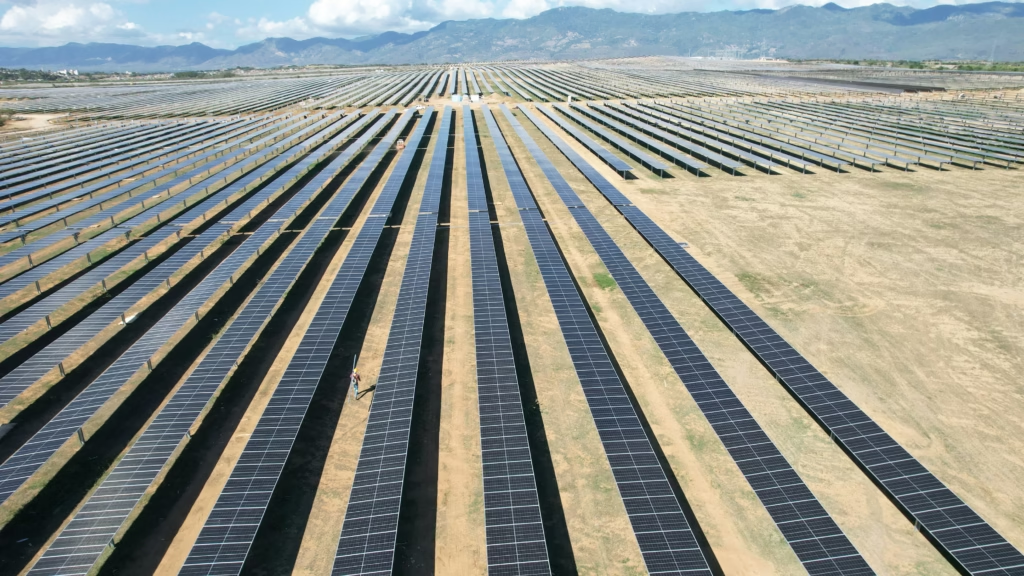
Within weeks of each other, two of Southeast Asia’s largest state utilities opened the region’s biggest solar tenders to date. Malaysia’s LSS6 and Indonesia’s Mentari Nusantara I are comparable in ambition and timeline, but they differ on one design choice that matters more than either headline capacity number: whether storage is part of the procurement at all.
What each tender actually covers
LSS6, launched by Malaysia’s Ministry of Energy Transition and Water Transformation (PETRA), carries a quota of 2,500MW of solar paired with 1,250MW of battery energy storage system (BESS) capacity, plus a further 150MW of standalone solar reserved for Bumiputera companies. The programme is expected to attract RM13–15 billion in investment, with commercial operation targeted by 31 December 2029.
Mentari Nusantara I, launched by Indonesia’s state utility PT PLN on 30 April 2026, covers 1,225MW of solar spread across six regions: Java (600MW), Kalimantan (340MW), Maluku and Papua (120MW), West Nusa Tenggara (80MW), Sulawesi (50MW), and Sumatra (35MW). It runs through a new procurement model called Giga One, which bundles multiple project sites into a single package to improve bankability. Commercial operation is also targeted for 2029.
The gap that matters: storage is mandatory in one, absent in the other
LSS6 bundles storage into the award itself: every solar package comes with a BESS requirement, at roughly a 2:1 solar-to-storage ratio. Mentari Nusantara I, by contrast, is a pure solar tender — no storage component is included in this round. PLN has said the Giga One procurement model will eventually be extended to hydro, wind and BESS projects, but as launched, Mentari Nusantara I does not require developers to pair storage with the solar capacity they win.
That is the more telling difference between the two tenders, more than the roughly 1,000MW gap in headline solar capacity. Malaysia’s grid operator is treating flexibility as something to procure alongside generation, in the same award. Indonesia’s largest current solar programme is not, at least not yet.
What this means for MESA members
For developers and equipment suppliers weighing where to expand next, the two tenders imply different near-term opportunities. LSS6 is a direct storage market: winning a package means delivering BESS, not just panels. Mentari Nusantara I is currently a solar-only opportunity — the storage demand PLN has signalled for future rounds is not yet a contracted requirement. Members active in both markets should track whether Indonesia’s BESS-specific procurement, when it comes, follows Malaysia’s bundled model or runs as a separate tender track.