
 翻译
翻译
By Prof. Madya Ir. Ts. Dr. Jasrul Jamani Bin Jamian President, Malaysia Energy Storage Association
Malaysia is taking a bold step forward. Under the National Energy Transition Roadmap, we are targeting 58 percent of our national energy capacity to come from solar PV by the year 2050. This massive shift is driven by three strategic national objectives. First, we aim to fulfil our commitment to achieving net-zero greenhouse gas emissions by 2050 to combat climate change. Second, we must strengthen our absolute energy security by reducing our heavy reliance on depletable fossil fuels through a highly optimized generation mix. Finally, we want to foster a resilient green economy that stimulates advanced industrial growth without ever compromising the overall stability and reliability of our power grid.
When people hear about relying heavily on solar power, a common assumption naturally follows. Since sunlight is completely free and requires no combustion, many assume our energy generation costs will automatically plummet. That statement is true to a certain extent. However, when we analyze the entire picture from a Levelized Cost of Energy (LCOE) perspective, specifically combining the PV plant plus storage over the long term, developing clean energy at a national scale is actually quite expensive.
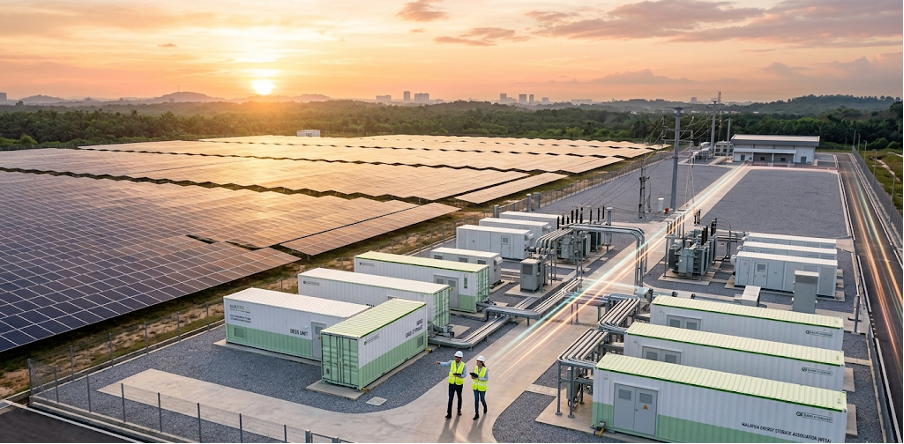
Solar power is an intermittent and uncontrollable resource. When clouds roll in, generation drops instantly. To compensate for this sudden drop, an Energy Storage System becomes the vital backbone of the entire grid. The system must react in a fraction of a second to maintain our energy balance while strictly preserving the network frequency. Beyond mere backup power, a robust storage network provides critical ancillary services to the grid operator. It enables peak shaving during peak demand hours, prevents the waste of excess solar energy during midday generation peaks, and provides vital voltage support. Most importantly, these systems are the definitive answer to the infamous duck curve dilemma. By soaking up the massive oversupply of solar generation at noon and discharging that exact power during the steep surge in evening demand, storage effectively flattens the load curve and prevents grid instability. From a broader economic standpoint, deploying strategic storage assets can actually delay the need to build incredibly expensive new transmission lines. In essence, proper energy storage converts unpredictable weather conditions into a reliable, dispatchable power supply.
Just as we have various types of traditional power plants to manage base and peak loads, we also have a diverse mix of storage technologies available. We can utilize Pumped Hydro Energy Storage (PHES), Compressed Air Energy Storage (CAES), Flywheel Systems, And Battery Energy Storage Systems (BESS). Each technology has distinct characteristics regarding energy density, power density, recommended operating time, and response speed. Integrating any of these systems means adding a massive capital expenditure on top of the initial solar infrastructure. Therefore, it is absolutely critical that the specific capabilities of the installed systems perfectly align with the specific technical demands of our national grid.
At this initial stage, Malaysia is moving aggressively towards BESS. The primary reason is entirely practical: BESS offers a much shorter deployment lead time than massive civil projects like pumped hydro. We are already seeing concrete progress on the ground. Two major utility-scale projects have successfully been completed in Sabah and Sarawak, boasting impressive capacities of 100MW/400MWh and 60MW/82MWh, respectively. Meanwhile, Peninsular Malaysia is currently constructing its very first 100MW/400MWh facility, and several more projects with identical capacities are in the immediate pipeline. Recognising the need for a diversified energy storage portfolio, Malaysia is also in the planning stages for the first-ever Pumped Hydro Energy Storage facility in the Peninsula.
The journey towards our 2050 energy goals is an engineering marathon. It requires more than just installing millions of solar panels. It demands deep technical foresight and rigorous financial planning. Transitioning to green energy is a costly investment, but it is an investment we absolutely must make to secure our economic and environmental future. As we deploy more storage assets across the country, the industry needs to collaborate closely. We must optimise how we operate these current systems and continuously explore diverse storage technologies that make long-term commercial sense.