
 翻译
翻译
By: Dr. Aznan Ezraie Ariffin, Chief Strategy Officer, TNB Research
Malaysia is building solar capacity at record pace. But as the share of variable renewables on the national grid grows, a different kind of challenge is quietly becoming urgent — not how to generate more power, but how to manage demand more intelligently. At the heart of this challenge sits an unlikely opportunity: Malaysia’s rapidly expanding base of large electricity consumers, particularly data centres, may hold the key to a more flexible, cost-efficient energy system.
This is the core argument emerging from Malaysia’s Green Energy Future Dialogue Series, and it deserves far more attention from the energy storage industry than it has received.
The Problem Hidden in Plain Sight
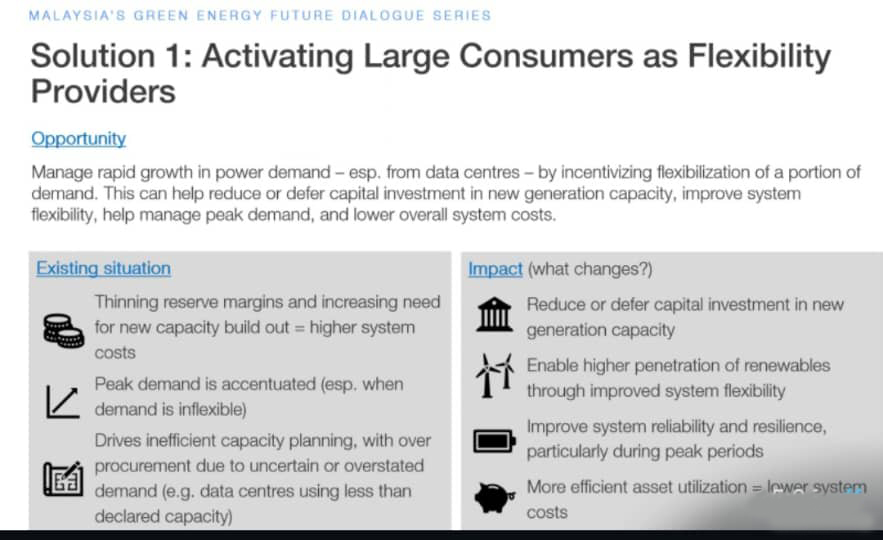
Reserve margins on Peninsular Malaysia’s grid are thinning. As demand grows — particularly from energy-intensive sectors like data centres, industrial facilities, and commercial real estate — the conventional response is to build more generation capacity. But this is an expensive and ultimately short-sighted solution. A growing body of evidence suggests that a significant portion of declared peak demand is structurally overstated: large consumers routinely reserve far more grid capacity than they actually use, driving unnecessary infrastructure investment and increasing system costs for everyone.
The result is a feedback loop that works against the energy transition. More generation capacity means higher system costs. Higher costs create pressure against the renewable expansion needed to hit Malaysia’s 2050 net-zero commitments. And a grid that cannot absorb variable supply reliably makes every additional megawatt of solar harder to integrate.
The Case for Demand-Side Flexibility
The solution does not require new technology. It requires a restructured relationship between large consumers and the grid — one built on price signals rather than blanket reliability guarantees.
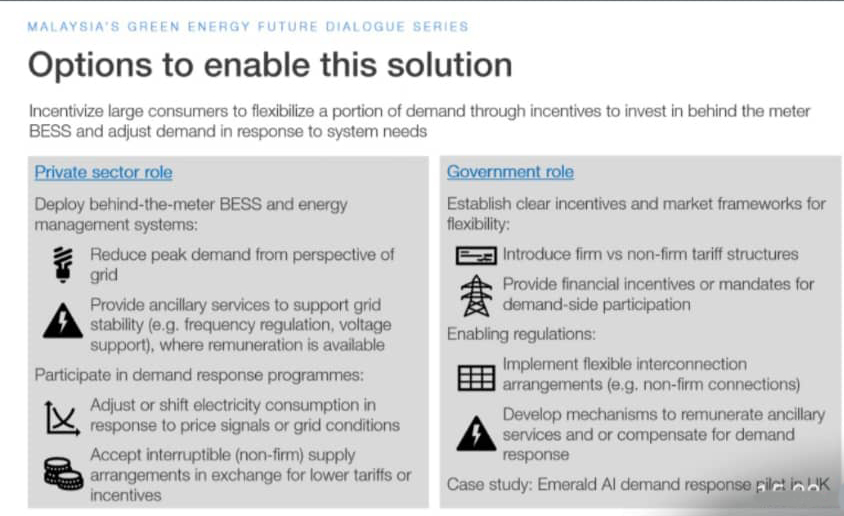
The principle is straightforward: consumers who demand guaranteed, uninterruptible supply should pay a premium for it. Consumers willing to accept some degree of interruptibility — reducing or shifting load when the grid signals stress — should receive meaningfully lower tariffs in return. This “firm versus non-firm” tariff differentiation is, in the assessment of Malaysia’s dialogue process, the single most effective lever available for unlocking demand-side flexibility at scale.
For the energy storage industry, this framing has direct commercial implications. Behind-the-meter battery storage becomes the enabling technology for large consumers to participate in flexibility markets: a data centre or industrial facility that installs a BESS can maintain operational continuity while accepting non-firm supply terms from the grid, capturing the tariff savings while discharging its stored energy during contracted flexibility windows. Storage, in this model, is not just a grid asset — it is an operational insurance policy that makes demand-side participation commercially viable.
A Practical Sequencing for Implementation
Not all flexibility is created equal. The dialogue process identifies a clear priority sequence for how demand-side flexibility should be developed in Malaysia’s context:
First, peak shaving — reducing the peak demand that large consumers draw from the grid during high-stress periods. This delivers immediate system value and requires relatively straightforward metering and control infrastructure. Second, behind-the-meter storage — deploying BESS at consumer sites to buffer demand variability, improve power quality, and enable participation in demand response schemes. Third, structured demand response — formal programmes through which consumers adjust consumption in direct response to grid price signals or operator instructions. Only after these foundational layers are in place should more complex ancillary service markets, such as frequency regulation or voltage support, be layered on.
This sequencing matters because it places the most commercially accessible opportunities first, creating a pathway for early movers to generate returns while the broader regulatory framework matures.
The Real Barriers Are Structural, Not Technical
It would be a mistake to frame resistance to demand-side flexibility as a technology problem. The technology — BESS, energy management systems, advanced metering infrastructure — is available, proven, and increasingly cost-competitive. The real barriers are structural and behavioural.
Data centres, as the most prominent category of large electricity consumers in Malaysia’s current growth cycle, are a useful case study. These facilities are engineered around a single overriding priority: uptime. Any flexibility arrangement that could compromise availability — even marginally — faces institutional resistance regardless of the financial incentives on offer. Overcoming this requires not just better tariff design, but credible technical protocols that demonstrate flexibility can be delivered without operational risk. Measurement and verification frameworks are essential: if grid operators and consumers cannot agree on how demand flexibility is quantified and attributed, no financial incentive structure will be sufficient to drive participation at scale.
Perhaps most importantly, accurate demand forecasting must replace the current culture of capacity over-declaration. When large consumers systematically overstate their grid requirements, the result is ghost capacity that the system must fund but never uses — a hidden tax on every electricity consumer in the country.
Starting Without Waiting
The most actionable insight from the dialogue process may be the simplest: pilots do not require new regulation to begin. Tenaga Nasional Berhad (TNB), working directly with willing large consumers, can initiate controlled demand response trials, test aggregated load reduction protocols, and develop the technical verification standards that any future formal market will require. The regulatory framework can follow demonstrated results — a more pragmatic path than waiting for comprehensive policy before testing what actually works.
For MESA members across the storage technology, project development, and system integration segments, this represents a clear near-term opportunity. The consumers are there. The technology is ready. The financial logic is compelling. What is needed now is the industry leadership to translate dialogue into deployment.
Written by Flora Zhang, who covers Malaysia and ASEAN energy storage — policy, tenders and revenue mechanisms — for MESA.